 |
 |
|
Home
THE STORY of THE TURKEY FARM
Owners Marilyn and Bob Neal and the crews who have worked here over the
years built The Turkey Farm into Maine's largest Turkey farm. In 2012,
The Turkey Farm entered its 27th year. Also in 2012, Marilyn
entered her 70th year and Bob entered his 73rd year. Age and health have
forced us to reduce the scale of the farm.
Our farm has thrived on repeat business. We have nearly 100 sharers in
Community Agriculture and we sell at farmers markets in Brunswick
(year-round) and South Portland (May-October). At Thanksgiving, more
than 80 percent of our customers return each year. We believe they come
back because of the taste and texture of our Turkeys. And, while
we have scaled back, the taste and texture of our Turkeys will not
change because our philosophy of farming has not changed.
Our 60 acres have about seven acres of fenced range, and we rotate
ranges so that none is occupied by Turkeys for more than 24 months in
60. For parts of every season, each range lies fallow so the perennial
grasses and other growth can rejuvenate after Turkeys have been on the
range. We try to populate the ranges at no more than 300 adult Turkeys
per acre, about 150 square feet per bird.
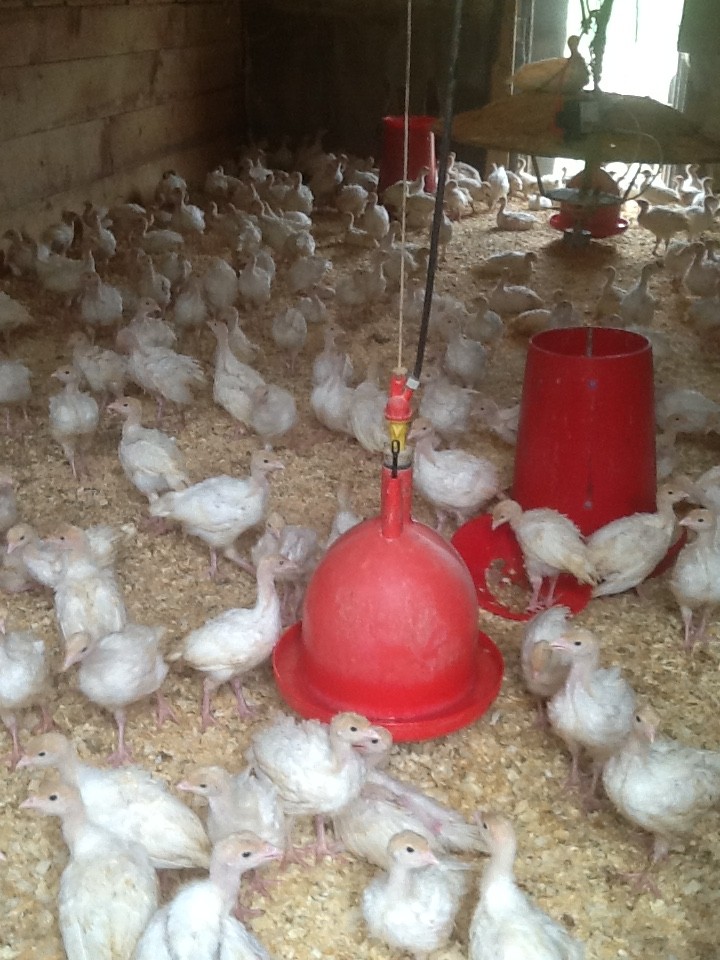
The litter from the farm's brooderhouse, where Turkeys spend their first
few weeks until their feathers have grown in to insulate them from the
weather, is composted and spread on the family's garden and sold
to other gardeners.
From 2001 to 2011, we used only feed that had been certified to be free
of genetically engineered grains. To our knowledge, no other farm in New
England has taken this step. Late in 2011, though, the Canadian
government closed the mill producing our feed, and we lost our gmo-free
supply. We are looking for a new source now and have feelers out to
sources in Iowa, Vermont and Quebec.
Using genetically clean feed is in keeping with our philosophy of
walking lightly on the land. We believe that genetic engineering works
more to the advantage of the corporations that own the seed patents than
to the animals and people who eat the food. And, so far, the yields with
genetically modified seed don't surpass the
yields of conventional seed. We also fear that not enough is known about
such effects as drifting for genetically modified feed to be assuredly
safe. The cost of our feed has more than tripled, owing mostly to the
federal mandate to use feed corn to produce ethanol, which has driven
the price of corn from less than $3 a bushel to
sometimes more than $8.
We raise our Turkeys as close to naturally as we can, and we operate our
farm as sustainably as we can. Click on Newsletter, Spring 2011, to read
about or efforts at sustainability.
We get the taste and texture that bring customers back again and
again by raising and processing our birds differently from those of
big-store growers. Starting with the commitment to free ranging our
birds, we stay as natural as we can. We give our birds no routine
antibiotics, although we will treat sick or clearly threatened birds
with whatever medications appear most likely to help. We last used
antibiotics farm-wide in 2004, at the end of an outbreak of fowl
cholera. At the end of the 2010 season, we had another outbreak of
cholera and applied first penicillin and then oxy-tetracycline to three
of our six flocks. We have not had to use any medications since. We
never use hormones, which are illegal for poultry.
At slaughter, we add no chemical "flavor enhancers" to the meat. We
don't have to. Conventional Turkeys may contain up to 8.5 percent (1.7
pounds in a 20-pound bird) of a chemical broth intended to add flavor.
We are a local business, and we try to buy locally anything that we
can't raise on the farm. Click on Newsletter, Spring 2010, to find out
more about our local orientation.
The Turkey Farm had its beginnings in 1980 when Marilyn and Bob Neal
came to New Sharon, hoping to make their living from the land. Bob had
had a 20-year career in newspapers and for the first three years
in Maine, he farmed and taught journalism at the University of Maine.
Marilyn and Bob have two sons, Robbie, who was 8 when the family moved
here, and Chris, who was 4. Both live in Portland, and neither wants to
assume operation of the farm when their parents get done. Marilyn worked
in records-keeping in the home-health industry for13 years before
joining the farm crew in 2002.
As subsistence farmers, the Neals grew a little of everything, including
a full line of vegetables, most of which they sold at farmers markets,
and poultry and pork. But subsistence farming is a difficult choice both
for the wallet and the lifestyle. "Do you know how many radishes you
have to pull to make a living?" Bob asked
fellow back-to-the-landers. After six years of augmenting farm income by
working out, Bob reduced the outside workload to part-time and began to
concentrate on Turkeys.
In 1986, he and Marilyn started 100 Turkeys, 91 making it to market
weight, and all sold at the farm for Thanksgiving and Christmas. The
Turkey Farm was on its way.
The next year, we grew 300 Turkeys and the next, 800. In 1989, we raised
the bar too high and raised 2,200, distributing a great many to stores
at wholesale prices that turned out to be way too low, and the farm lost
$15,000 (nearly $7 a bird). "Wow," one farmer said, "I thought you had
to raise sheep to lose that much money per animal."
The farm cut back to 1,400 birds the next year and then resumed gradual
growth until it peaked in 1994 at 4,400. The total flock fluctuated
between 3,300 and 4,100 for 11 seasons, then settled in at 3,200 for
several years. This year it will be about 2,200.
In 1987, the farm started its food concession, which may be where most
people have learned about us. We sold dinners and sandwiches for 21
years at the Fryeburg Fair, where we won the prize in 1998 for best
food. Click on Newsletter, Summer, 2011, to read more about our time at
Fryeburg.
In 1989, The Turkey Farm began selling what are called further-processed
items to stores, primarily natural-food and always locally owned stores.
The further-processed items (see list) gradually became a major part of
the business, and kept the farm in production year-round. We continued
wholesaling until health forced
us to retrench to retail only in 2010. Today, we continue to pack the 40
or so further-processed items for sale at retail at the farm and at
farmers markets. In early 2012, we resumed wholesaling to a handful of
carefully chosen stores and kitchens.
In 1990, we became the second farm in Maine to offer Community Supported
Agriculture. Under Community Supported Agriculture, sharers pay up-front
for their food and then collect (with interest) as the harvest comes in.
Click on Newsletter, Spring 2012, to learn more about our CSA and how to
join.
Our farmstore on Route 27 in New Sharon began as the front room of our
slaughterhouse, which was built in 1990. The carpenters were finishing
in the front room as we began processing Thanksgiving Turkeys in the
back room that year. Two years later, using a loan from Coastal
Enterprises, Inc., we built a 1,008-square-foot
brooderhouse where our birds begin their lives. The house is heated with
propane stoves to warm the baby Turkeys, which we pick up at hatcheries
the day of hatch, until their feathers grow in.
Two years later, we added to the slaughterhouse so we'd have more room
for processing, and three years after that, we built a 576-square-foot
ell onto the plant to be our farmstore.
Our farm symbol came to us in 1998 when our son Robbie painted a mural
that we display in our farmstore. From that mural, we took the image of
The Versatile Turkey, a Tom Turkey who balances on a
rolling ball while juggling plates, rings and ten-pins, and made it our
farm logo.
In 1999, we knew we would have to expand our refrigeration, so we bought
a refrigerator truck, which we could use for deliveries and for
stationary storage. Three years later, we bought a second reefer truck,
which we use for cold storage at the farm at Thanksgiving. A third
reefer truck joined our fleet in 2006.
Since 2007, Marilyn has been fighting ovarian cancer, and in 2010, Bob
suffered a heart attack. Obviously, we had to cut back our farming. For
the future, our business is limited to retail sales here at the farm and
at the farmers markets in Brunswick and South Portland and to a bit of
wholesaling. We intend to keep growing
Turkeys for at least a couple more seasons.
|
|
 |


|

 |